
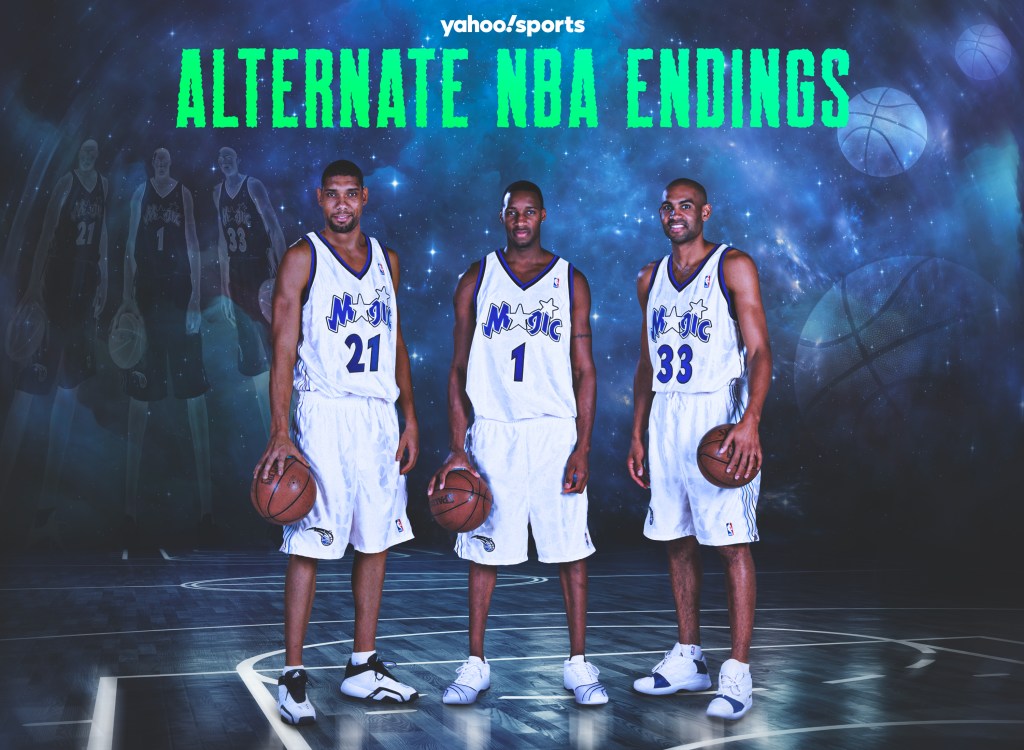
On July 1, 2000, the NBA’s free agency period opened. While there were a lot of good players available, three names stood above the rest: Grant Hill, Tracy McGrady, and Tim Duncan. The Orlando Magic went to work right away, acquiring both Hill and McGrady from their respective teams. According to Duncan, Orlando was “real close” to signing him as well. However, reports have circulated (and been supported by Hill) that Doc Rivers—Orlando’s head coach at the time—told Duncan that he would not allow family members to fly on the team plane. While Hill believes that was the reason, Rivers believes it was because Orlando gave the San Antonio Spurs (Duncan’s incumbent team) one more chance to talk to Duncan before he made his decision.
With Duncan deciding to re-sign with San Antonio, the question remains: What if he decided to sign with Orlando and join forces with Hill and McGrady?
Guidelines
Before we evaluate this “What if,” here are a few guidelines/assumptions to keep in mind:
1.) This “What if” will start with the 2000-01 season (the season where Duncan made his decision) and end with the 2015-16 season (his last year).
2.) Since the Orlando Magic and San Antonio Spurs are in different conferences (Orlando’s in the Eastern Conference and San Antonio’s in the Western Conference), this “What if” will keep track of the success of both teams from 2000-2016.
3.) Duncan’s actual stats for each season will be listed, and changes in team W-L projections will be based heavily on Expected W-L (similar to Pythagorean W-L) and Duncan’s Win Shares (WS).
4.) In the playoffs, if the series didn’t take place in real life, the projected winner will likely be based off the head-to-head record between the teams in the regular season. Some exceptions will be made.
2000-01 Season
Duncan’s Stats: 82 games (G), 22.2 points per game (PPG), 12.2 rebounds per game (RPG), 3 assists per game (APG), 0.9 steals per game (SPG), 2.3 blocks per game (BPG), 13.2 WS
Orlando Magic record: 43-39, lost in Eastern Conference first round
San Antonio Spurs record: 58-24, lost in Western Conference Finals (WCF)
Magic: In this universe, since Orlando would have Duncan, Tracy McGrady, and Grant Hill, this season would be a “medical redshirt” season for Hill, who broke his ankle the year before and continued to play through the injury into the playoffs. While losing Hill in other seasons might’ve hurt Orlando, he only played four games in the 2000-01 season (he also ended up sitting out for the whole 2003-04 season due to this injury).
Without Hill, I believe Duncan and McGrady (26.8 PPG, 7.5 RPG, 4.6 APG, 1.5 SPG, 1.5 BPG, 12.2 WS) still have numbers comparable to their real-life stats. The addition of Duncan propels Orlando to 57 wins (their expected W-L was 44-39) and sole possession of the first overall seed in the Eastern Conference. This sets them up for a first round date with the Indiana Pacers. In a tightly contested series, Orlando wins in five games.
In the Eastern Conference semifinals (ECSF), despite having Duncan, Orlando loses to the Miami Heat, who held a 3-1 head-to-head record over Orlando in the regular season.
Spurs: Without Duncan, San Antonio still has a nice season, as most of their core players from the 1998-99 championship team are still there. They still win 50 games (their expected W-L was 63-19), but they fall from first place in the Western Conference to being tied for the sixth overall seed with the Portland Trail Blazers. With a 3-1 head-to-head record over Portland, San Antonio holds the tiebreaker for the sixth seed, setting them up to face the Utah Jazz in the first round. San Antonio makes quick work of Utah, sweeping them in three games.
In the Western Conference semifinals (WCSF), San Antonio faces the Sacramento Kings. In a tightly contested series, they win in six games and advance to the WCF to face the Shaq and Kobe-led Los Angeles Lakers. Like they did in real life, San Antonio gets swept in four games by Los Angeles.
2001-02 Season
Stats: 82 G, 25.5 PPG, 12.7 RPG, 3.7 APG, 0.7 SPG, 2.5 BPG, 17.8 WS
Magic record: 44-38, lost in Eastern Conference first round
Spurs record: 58-24, lost in WCSF
Spurs: This season, the Spurs start to lose some of their core players. However, they still have center David Robinson, and they acquire small forward Bruce Bowen and draft point guard Tony Parker. Without Duncan, the Spurs win 41 games (their expected W-L was 59-23), causing them to drop to the eighth seed in the Western Conference. In the first round, San Antonio faces the Sacramento Kings, who held a 3-1 head-to-head record over San Antonio in the regular season. Just like the regular season, Sacramento wins the series in four games.
Magic: This season sees the return of a healthy Grant Hill for Orlando. While I think they manage Hill’s workload to a degree, I think he plays around the same amount of games and produces comparable numbers to his 2004-05 season (67 G, 19.7 PPG, 4.7 RPG, 3.3 APG, 1.4 SPG, 0.4 BPG, 6.6 WS). With the addition of a healthy Hill to team up with Duncan and McGrady (25.6 PPG, 7.9 RPG, 5.3 APG, 1.6 SPG, 1 BPG, 11.5 WS), Orlando finishes with 64 wins (their expected W-L was 46-36) and easily obtains the first seed in the Eastern Conference. Duncan also wins his first Most Valuable Player (MVP) award (like he did in real life).
For the second year in a row, Orlando faces Indiana in the first round and wins in four games (Hill did not play in three of the four regular season games in real life). In the ECSF, Orlando faces the Boston Celtics, where they win a tough series in six games (Hill did not play in any of the four regular season games in real life). In the Eastern Conference Finals (ECF), Orlando matches up against the Detroit Pistons. The series goes to seven games, but Orlando utilizes their home court advantage to win and advance to the NBA Finals.
In the Finals, Orlando faces Los Angeles, giving us two epic player matchups: Shaq vs. Duncan, and Kobe vs. McGrady. Orlando makes a valiant effort in this series, but LA’s Finals experience proves to be the difference. The Lakers win in six games and complete their three-peat.
2002-03 Season
Stats: 81 G, 23.3 PPG, 12.9 RPG, 3.9 APG, 0.7 SPG, 2.9 BPG, 16.5 WS
Magic record: 42-40, lost in Eastern Conference first round
Spurs record: 60-22, won NBA Finals
Spurs: In David Robinson’s swan song and Manu Ginóbili’s rookie season, San Antonio wins 40 games without Duncan (their expected W-L was 57-25) and misses the playoffs.
Magic: Coming off the NBA Finals loss, Orlando has another good regular season, winning 58 games (their expected W-L was 41-41) and claiming the best record in the Eastern Conference. Also, since Orlando has Duncan in tow, the front office does not trade 2001 Rookie of the Year (ROY) winner Mike Miller, who was traded to the Memphis Grizzlies to help Orlando acquire a big man (power forward Drew Gooden and guard Gordan Giriček were the players acquired). Duncan also wins his second MVP in a row (like he did in real life).
In the first round, Orlando faces the Milwaukee Bucks and wins in five games (the first round format changed from a best of five to a best of seven this season). In the ECSF, Orlando faces Indiana and wins in six games (Grant Hill did not play in two of the three regular season games). In the ECF, Orlando faces the Detroit Pistons for the second consecutive year. In real life, Detroit beat Orlando in the first round in seven games. However, in this universe, Orlando wins in six games, as they have Duncan, Hill, and Miller available.
In the Finals, Orlando faces Los Angeles again. Motivated by the previous year’s loss, along with LA’s fatigue from four straight Finals appearances, Orlando wins in five games. Duncan wins his second ring and Finals MVP respectively, and McGrady and Hill win their first championship.
2003-04 Season
Stats: 69 G (68 games started (GS)), 22.3 PPG, 12.4 RPG, 3.1 APG, 0.9 SPG, 2.7 BPG, 13.1 WS
Magic record: 21-61, missed playoffs
Spurs record: 57-25, lost in WCSF
Spurs: In their first season without both of the “Twin Towers” (Duncan and Robinson), San Antonio wins 49 games (their expected W-L was 62-20). However, they drop from the second seed to the sixth seed in the Western Conference. In the first round, they face Sacramento and lose in six games.
Magic: Coming off their Finals win, Orlando begins its quest to repeat with Duncan, McGrady, and two players in Hill (who missed the entire ’03-04 season in real life) and Miller. With the additions of Duncan, Hill (6.6 WS; projected to have stats similar to his ’04-05 season again) and Miller (3.9 WS with Memphis), Orlando wins 46 games (their expected W-L was 22-60) and claims the fourth seed in the Eastern Conference. Also, Orlando likely doesn’t sign forward Juwan Howard in the offseason, as they likely don’t have the cap space to sign him and keep Duncan, Hill, McGrady, and Miller (who signed a six-year contract extension with Memphis in October 2003) together.
In the first round, Orlando faces Miami, who held a 4-0 head-to-head record over Orlando in real life. However, with Duncan (21 points, 19 rebounds, 5 blocks in his lone game against Miami), Hill, and Miller (18 points, 4 assists in his lone game against Miami) supporting McGrady, Orlando wins in seven games. In the ECSF, Orlando faces Indiana, who held a 3-1 head-to-head record over Orlando in real life. This time, Duncan (23 PPG, 12 RPG, 4.5 APG, 1.5 SPG, 4 BPG in two games against Indiana) puts the team on his back and Orlando wins in seven games. In the ECF, Orlando faces Detroit for the third straight year. While Detroit held a 3-1 head-to-head record over Orlando, Tracy McGrady (25 PPG, 5 RPG, 8.5 APG, 2 SPG in two games against Detroit) takes over and helps Orlando advance to the NBA Finals in seven games.
In the NBA Finals, Orlando faces the Minnesota Timberwolves and 2004 MVP Kevin Garnett. The series goes to seven games, with Garnett and Duncan trading memorable moments. In Game 7, tied at 101, Doc Rivers draws a play for McGrady, and he hits a stepback buzzer-beater over guard Latrell Sprewell to give Orlando back-to-back championships. While McGrady gets votes, Duncan wins his third Finals MVP, as his stats (I believe he gets somewhere close to his real-life stats: 27.3 PPG, 11.5 RPG, 3.8 APG, 0.5 SPG, 1.5 BPG in four games) and matchup with Garnett helps him win.
2004 NBA Draft
With Orlando no longer being in the lottery, the Chicago Bulls receive the best odds and win the first overall pick (Orlando had the best odds in real life). With that pick, Chicago selects center Dwight Howard. Also, Boston (who originally made the playoffs with a 36-46 record) gets the 10th pick after missing the playoffs in this universe.
2004-05 Season
Stats: 66 G, 20.3 PPG, 11.1 RPG, 2.7 APG, 0.7 SPG, 2.6 BPG, 11.2 WS
Magic record: 36-46, missed playoffs
Spurs record: 59-23, won NBA Finals
Spurs: Without Duncan, San Antonio wins 52 games (their expected W-L was 63-19). However, they drop from the second seed to the fourth seed, due to the Seattle SuperSonics winning the tiebreaker for the third seed by winning the Northwest division. In the first round, they face the Houston Rockets and win in seven games.
In the WCSF, San Antonio faces the Phoenix Suns and wins in six games (San Antonio held a 2-1 regular season head-to-head record and won in five games in the WCF against Phoenix in real life). In the WCF, San Antonio faces the Dallas Mavericks, who they held a 3-1 head-to-head record over. Again, San Antonio wins in six and punches their ticket to the Finals.
Magic: In this universe, with back-to-back championships and players like Mike Miller still in Orlando, Tracy McGrady does not get traded in the offseason to the Houston Rockets. With McGrady (78 G, 25.7 PPG, 6.2 RPG, 5.7 APG, 1.7 SPG, 0.7 BPG, 12 WS) still with Orlando, the Magic win 58 games (their expected W-L 35-47) and clinch the second overall seed in the Eastern Conference.
In the first round, Orlando faces Indiana and wins in five games (Surprisingly, Orlando held a 3-1 head-to-head record over Indiana in real life). In the ECSF, Orlando faces Detroit again. While Detroit held a 3-1 head-to-head record in real life, Orlando’s “mental edge” and “championship pedigree” helps them win in seven games. In the ECF, Orlando faces Miami, who completed a regular season sweep for the second straight year in real life. While this series goes to seven games, Orlando wins, as Duncan, McGrady and Hill shine and help Orlando advance to the NBA Finals.
2005 NBA Finals
In a matchup filled with storylines (particularly Duncan vs. his old team), San Antonio and Orlando face off in the NBA Finals. This series is reminiscent of the “What if?” 2002 NBA Finals (Orlando vs. LA), as San Antonio pushes Orlando to their limits. However, Orlando wins the series in six games, matching them with the Shaq and Kobe Lakers as the only teams to win three straight championships in the new millennium.
Tim Duncan wins his third straight Finals MVP (and fourth overall), while Tracy McGrady and Grant Hill celebrate their third Finals victory.
2005-06 Season
Stats: 80 G, 18.6 PPG, 11 RPG, 3.2 APG, 0.9 SPG, 2 BPG, 10.8 WS
Magic record: 36-46, missed playoffs
Spurs record: 63-19, lost in WCSF
Magic: This season, the deep postseason runs take their toll, as McGrady and Hill both miss a significant amount of time (McGrady played 47 games in real life, while Hill only played 21). However, behind Duncan and Mike Miller (74 G, 13.7 PPG, 5.4 RPG, 2.7 APG, 7.4 WS), Orlando wins 56 games (their expected W-L was 38-44), netting them the second seed in the Eastern Conference.
In the first round, Orlando faces Indiana, who held a 3-0 head-to-head record over Orlando in real life. However, Orlando wins in six, despite receiving no contributions from McGrady and Hill (McGrady’s last regular season game was March 8; Hill’s was March 10). In the ECSF, Orlando faces Miami again. However, without Hill and McGrady, Orlando is unable to match Miami’s talent, and they lose in five games.
Spurs: San Antonio wins 50 games without Duncan (their expected W-L was 61-21), netting them the third seed in the Western Conference.
In the first round, San Antonio faces the Lakers, who they held a 2-1 head-to-head record over, and wins in six games. In the WCSF, San Antonio faces Dallas. The series goes to seven games, but Dallas’ home court advantage helps them advance to the WCF.
2006-07 Season
Stats: 80 G, 20 PPG, 10.6 RPG, 3.4 APG, 0.8 SPG, 2.4 BPG, 13 WS
Magic record: 40-42, lost in Eastern Conference first round
Spurs record: 58-24, won NBA Finals
Spurs: Without Duncan, San Antonio wins 51 games (their expected W-L was 64-18). However, they drop from the third seed to the fifth seed in the Western Conference, due to the Utah Jazz winning the Northwest division and gaining the tiebreaker for the fourth seed. In the first round, San Antonio faces Utah and wins in seven games. In the ECSF, San Antonio faces the Golden State Warriors and win in five games.
In the WCF, San Antonio faces Phoenix. While San Antonio won in six games in real life, not having Duncan proves to be a huge factor in this series. Also, there is still a belief that Phoenix would’ve won the series if this never happened. Without Duncan, Phoenix wins in five, despite great performances from Tony Parker and Manu Ginóbili.
Magic: This season, McGrady and Hill both rebound from their injuries and provide Duncan with the help needed to get Orlando 67 wins (McGrady and Hill combined for 13.7 WS) and the first seed in the Eastern Conference.
In the first round, Orlando faces the Washington Wizards. The series goes to seven games, but Orlando wins and advances to the second round. In the ECSF, Orlando faces the Chicago Bulls, who they held a 2-1 head-to-head record over. Orlando wins in six games and advances to the ECF, where they face the Cleveland Cavaliers. Led by LeBron James, Cleveland puts up a valiant effort, but Orlando wins in six games to advance to the NBA Finals.
In the Finals, Orlando faces Phoenix, who held a 2-0 head-to-head regular season record over Orlando. This series proves to be an instant classic, as it goes seven games. However, Orlando’s supporting cast proves to be a little better than Phoenix’s, as McGrady and Hill provide star-like performances, and Miller provides strong contributions off the bench. In what is likely the closest Finals MVP race ever, McGrady wins his first Finals MVP.
2007-08 Season
Stats: 78 G, 19.3 PPG, 11.3 RPG, 2.8 APG, 0.7 SPG, 2.6 BPG, 11.1 WS
Magic record: 52-30, lost in ECSF
Spurs record: 56-26, lost in WCF
Spurs: This season, San Antonio wins 44 games (their expected W-L was 55-27). This causes them to fall from the third seed to missing the postseason.
Magic: This season, Orlando wins 63 games. However, they finish second in the Eastern Conference to the Boston Celtics, who still team Kevin Garnett and Ray Allen up with Paul Pierce to form their own Big 3.
In the first round, Orlando faces the Philadelphia 76ers, who they held a 3-1 head-to-head record over, and wins in five games. In the ECSF, Orlando faces Detroit. While Detroit won in six games in real life, Orlando’s only star was Dwight Howard. In this universe, the series goes seven games, but the Big 3’s contributions prove to be just enough to help them advance to the ECF.
In the ECF, Orlando faces Boston in a battle of the Big Threes. While the series goes to seven games, Boston’s home court advantage helps them win Game 7 and advance to the NBA Finals.
2008-09 Season
Stats: 75 G, 19.3 PPG, 10.7 RPG, 3.5 APG, 0.5 SPG, 1.7 BPG, 10.1 WS
Magic record: 59-23, lost NBA Finals
Spurs record: 54-28, lost in Western Conference first round
Spurs: San Antonio wins 42 games (their expected W-L was 52-30) and misses the postseason for the second consecutive season.
Magic: This season, injuries start to catch up to McGrady (he only played 35 games in real life), leaving Hill (82 G, 12 PPG, 4.9 RPG, 2.3 APG, 1.1 SPG, 0.7 BPG, 5.3 WS) and Miller (73 G, 9.9 PPG, 6.6 RPG, 4.5 APG, 4.2 WS) with more responsibility. Both players have similar statistical seasons to what they did in real life, helping Orlando win 69 games and pass Cleveland for the first overall seed in the Eastern Conference.
In the first round, Orlando faces Detroit, who held a 3-0 head-to-head record over Orlando. Despite the record, Orlando wins in six games, as the loss of Chauncey Billups (traded to Denver) hurts Detroit. In the ECSF, Orlando faces Boston. Without Kevin Garnett, Boston struggles to contain Tim Duncan and Grant Hill. As a result, Orlando wins in six games. In the ECF, Orlando faces Cleveland. Like they did in real life, Orlando wins in six games to advance to the NBA Finals.
Like they did in real life, Orlando faces the Lakers in the Finals. While Duncan, Hill and Miller play well, the loss of McGrady looms large, as the Lakers win in six and Kobe Bryant claims his fourth championship and first Finals MVP.
2009-10 Season
Stats: 78 G (77 GS), 17.9 PPG, 10.1 RPG, 3.2 APG, 0.6 SPG, 1.5 BPG, 10.9 WS
Magic record: 59-23, lost in ECF
Spurs record: 50-32, lost in WCSF
Spurs: San Antonio wins 44 games without Duncan (their expected W-L was 55-27). This allows San Antonio to make the playoffs, but they drop from the seventh seed to the eighth seed in the Western Conference.
In the first round, San Antonio faces Los Angeles, who wins the series in six games on their quest to win back-to-back championships.
Magic: This is the season where we start to see Tracy McGrady’s regression (he only played 30 games in real life). However, like the previous season, Hill and Miller continue to produce, helping Orlando win 66 games (their expected W-L was 61-21, but Duncan also had 2.3 fewer WS than Dwight Howard) and claim the first seed in the Eastern Conference.
In the first round, Orlando faces Chicago, who boasts a duo of Howard and point guard Derrick Rose. While both players show Chicago what the future holds, Orlando wins in six games. In the ECSF, Orlando faces Boston for the third consecutive season. Reflecting their 3-1 head-to-head record against Boston, Orlando wins in six and advances to the ECF. In the ECF, Orlando faces Cleveland again. Despite the 2-1 head-to-head record and LeBron’s dominance, Orlando wins in seven games to advance to the NBA Finals.
In what is later dubbed “The Year of the Rematch,” Orlando faces LA in the Finals again. This time, despite missing McGrady, Orlando pushes the series to seven games, where they lean on their home court advantage to win. Duncan wins his fifth Finals MVP, and Orlando celebrates their fifth championship.
2010-11 Season
Stats: 76 G, 13.4 PPG, 8.9 RPG, 2.7 APG, 0.7 SPG, 1.9 BPG, 7.7 WS
Magic record: 52-30, lost in Eastern Conference first round
Spurs record: 61-21, lost in Western Conference first round
Magic: This season, Orlando wins 57 games (their expected W-L was 56-26), placing them in a tie for the third seed with Boston. However, they fall to the fourth seed as Boston wins the tiebreaker by winning the Atlantic division.
In the first round, Orlando faces the Atlanta Hawks. Like they did in real life, Orlando wins in six games. In the second round, Orlando faces Chicago, who held a 3-1 head-to-head record over Orlando. While Duncan and Hill do as much as they can, the duo of Rose and Howard (the top two MVP finalists this season in real life) helps propel Chicago to the ECF in six games.
Spurs: This season, San Antonio wins 48 games (their expected W-L was 56-26). This causes them to drop from the first seed to the sixth seed.
In the first round, San Antonio faces the Oklahoma City Thunder, who they held a 3-0 head-to-head record over, and wins in six games. In the WCSF, San Antonio faces Dallas, who they held a 2-1 head-to-head record against. The series goes to seven games, but Dirk Nowitzki and the Mavericks hang on to win Game 7 at home.
2011 NBA Draft
In this universe, San Antonio still trades point guard George Hill to Indiana and selects small forward Kawhi Leonard with the 15th pick.
2011-12 Season
Stats: 58 G, 15.4 PPG, 9 RPG, 2.3 APG, 0.7 SPG, 1.5 BPG, 5.9 WS
Magic record: 37-29, lost in Eastern Conference first round
Spurs record: 50-16, lost in WCF
Magic: In Tracy McGrady’s swan song season, Orlando wins 41 games (their expected W-L was 35-31), landing them the fourth seed in the Eastern Conference.
In the first round, Orlando faces Atlanta, who held a 3-0 head-to-head record over Orlando. The series goes seven games, but Orlando’s home court advantage wins out. In the ECSF, Orlando faces Chicago again. Despite their best efforts, Chicago beats Orlando in six games.
Spurs: San Antonio wins 42 games without Duncan (their expected W-L was 48-18), but they only drop from the first seed to the second seed in the Western Conference.
In the first round, San Antonio faces Dallas and wins in six games. In the WCSF, San Antonio faces Los Angeles, who they held a 2-1 head-to-head record over, and wins in six games. In the WCSF, San Antonio faces Oklahoma City, where the trio of Russell Westbrook, James Harden and Kevin Durant prove to be too much for San Antonio to contain. As a result, Oklahoma City wins in six games and advances to the NBA Finals.
2012-13 Season
Stats: 69 G, 17.8 PPG, 9.9 RPG, 2.7 APG, 0.7 SPG, 2.7 BPG, 8.3 WS
Magic record: 20-62, missed playoffs
Spurs record: 58-24, lost NBA Finals
Magic: Orlando says farewell to another member of the Big 3, as this marks Grant Hill’s final season. Unfortunately for Orlando, they only win 30 games (their expected W-L was 22-60) and miss the postseason for the first time since Duncan joined McGrady and Hill.
Spurs: San Antonio wins 50 games without Duncan, dropping them from the first seed to the fifth seed. In the first round, San Antonio faces Memphis and wins in six games (they swept Memphis in the WCF in real life). In the WCSF, San Antonio faces Oklahoma City. The series goes to seven games, but Oklahoma City leans on their home court advantage to win.
2013-14 Season
Stats: 74 G, 15.1 PPG, 9.7 RPG, 3 APG, 0.6 SPG, 1.9 BPG, 7.4 WS
Magic record: 23-59, missed playoffs
Spurs record: 62-20, won NBA Finals
Magic: Orlando wins 33 games this season (their expected W-L was 26-56) and miss the postseason for the second consecutive season.
Spurs: San Antonio wins 54 games without Duncan (their expected W-L was 61-21), dropping them from the first seed to the fourth seed. In the first round, San Antonio faces Portland and wins in six games. In the WCSF, San Antonio faces Oklahoma City for the third straight season. With Harden departing for Houston in the offseason, San Antonio has an easier time containing the Thunder with rising star Kawhi Leonard. San Antonio wins in six games and advances to the WCF.
In the WCF, San Antonio faces the Los Angeles Clippers. The series goes to seven games, and Los Angeles advances to the NBA Finals after a tough shot by Chris Paul (eerily similar to this play).
2014-15 Season
Stats: 77 G, 13.9 PPG, 9.1 RPG, 3 APG, 0.8 SPG, 2 BPG, 9.6 WS
Magic record: 25-57, missed playoffs
Spurs record: 55-27, lost in Western Conference first round
Magic: Orlando wins 35 games this season and misses the playoffs for the third straight season.
Spurs: San Antonio wins 48 games without Duncan (their expected W-L was 58-24), dropping them from the sixth seed to the seventh seed. In the first round, San Antonio faces Houston, who they held a 3-1 head-to-head record over, and wins in six games. In the WCSF, San Antonio faces the Clippers again. Like the series in real life, Los Angeles uses their home court advantage to win in seven games.
2015-16 Season
Stats: 61 G (60 GS), 8.6 PPG, 7.3 RPG, 2.7 APG, 0.8 SPG, 1.3 BPG, 5.2 WS
Magic record: 35-47, missed playoffs
Spurs record: 67-15, lost in WCSF
Magic: In Duncan’s swan song season, Orlando wins 41 games (their expected W-L was 36-46) and misses the playoffs.
Spurs: This season, San Antonio wins 62 games, netting them the second seed in the Western Conference. Like they did in real life, San Antonio advances to the WCF behind the stellar play of Kawhi Leonard. However, they still lose to the 73-9 Golden State Warriors.
Review
In 19 seasons with San Antonio, Tim Duncan made the postseason 18 times, the WCF eight times, and won five NBA Finals (with three Finals MVPs) in six appearances. In this “What if,” Duncan made the postseason 12 times, the ECF eight times, and won five NBA Finals (with four Finals MVPs) in seven appearances. This allows Duncan to finish his career with six championships (5 Finals MVPs) and two regular season MVPs.
While Duncan’s legacy may be heightened slightly, the real differences in legacy can be found with both Orlando and San Antonio’s supporting casts. With five championships and a Finals MVP, Tracy McGrady puts himself in at least top 20 conversations, and he has an argument as the best shooting guard of the era (against Kobe and Dwyane Wade). Also, Grant Hill realizes some—if not most—of the potential people claimed he had, and he reaches the top 20-25 “greatest players of all time” conversation. Also, Duncan, McGrady and Hill all likely get their jerseys retired by Orlando. Finally, if Doc Rivers is the coach for all the championship runs (which likely happens after Orlando wins three straight), he is probably in the top 5 “greatest coaches of all time” conversation.
Meanwhile, San Antonio only has one ring (the 1998-99 championship they won with Duncan and David Robinson). While Tony Parker and Manu Ginóbili’s careers are still likely Hall of Fame worthy, their legacies may be slightly devalued, as they were unable to win a championship in this universe. Also, Gregg Popovich only has one ring as well, possibly causing him to fall in the greatest coach of all time ranks.
This scenario not only shows how much impact one player can have on a franchise in basketball, but it also shows how much it can change the legacies of those around them.
How do you think Orlando and San Antonio’s futures would’ve played out? Do you feel Duncan’s career arc would look similar or drastically different to his current one? Share your thoughts in the comments below!

 Brian's Deductions
Leave a reply to What if Tim Duncan Signed with the Orlando Magic? (Revision) – Brian's Deductions Cancel reply