
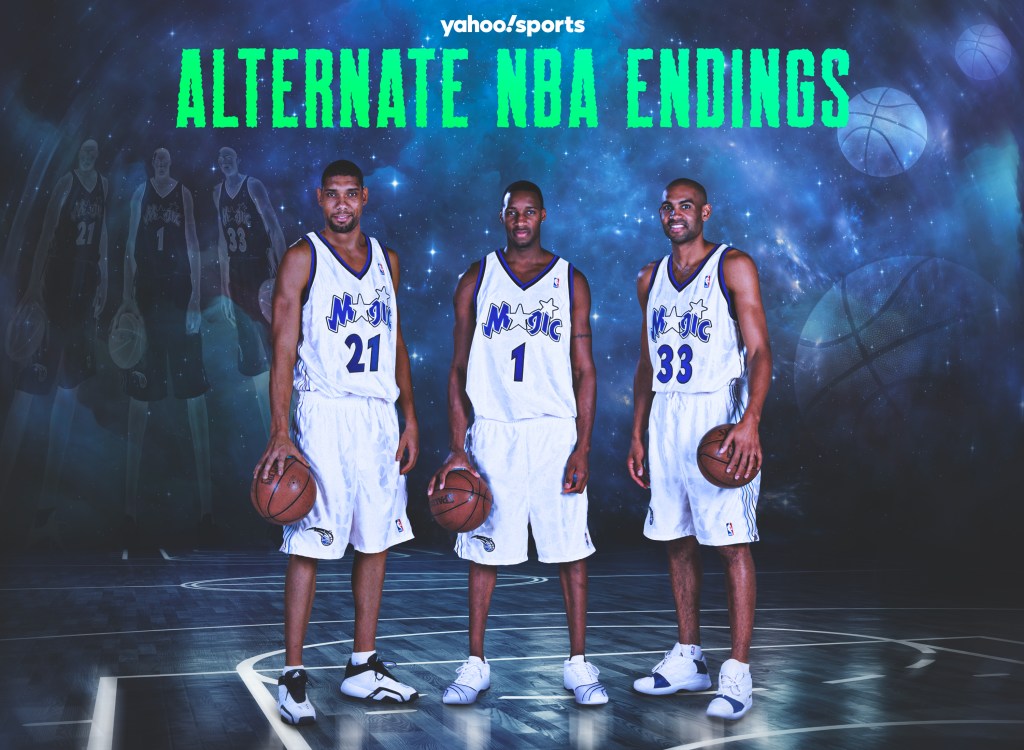
Editor’s note: This is a revision of the “What if?” Tim Duncan to Orlando article. This version will solely focus on the Orlando Magic, as the introduction of guideline 2a will make it difficult to include the San Antonio Spurs. For the original article, click here.
On July 1, 2000, the NBA’s free agency period opened. While there were a lot of good players available, three names stood above the rest: Grant Hill, Tracy McGrady, and Tim Duncan. The Orlando Magic went to work right away, acquiring both Hill and McGrady from their respective teams. According to Duncan, Orlando was “real close” to signing him as well. However, reports have circulated (and been supported by Hill) that Doc Rivers—Orlando’s head coach at the time—told Duncan that he would not allow family members to fly on the team plane. While Hill believes that was the reason, Rivers believes it was because Orlando gave the San Antonio Spurs (Duncan’s incumbent team) one more chance to talk to Duncan before he made his decision.
With Duncan deciding to re-sign with San Antonio, the question remains: What if he chose Orlando and joined forces with Hill and McGrady?
Guidelines
Before we evaluate this “What if,” here are a few guidelines/assumptions to keep in mind:
1.) This “What if” will start with the 2000-01 season (the season where Duncan made his decision) and end with the 2015-16 season (his last year).
2.) Duncan’s actual stats for each season will be listed, and changes in team W-L projections will be based heavily on Expected W-L (similar to Pythagorean W-L) and Net Win Shares (nWS).
2a.) Net Win Shares will factor in Duncan’s (and other teammates) Win Shares (WS) in comparison to the people they replace (e.g., Tim Duncan 16.2 WS vs. Dwight Howard 12.5 WS = 3.7 nWS)
2b.) The person that is being replaced will be placed in parentheses for their first respective season. If the replacement isn’t listed in subsequent seasons, then it is the same person (e.g., Dwight Howard from 2004-2012).
3) In the playoffs, if the series didn’t take place in real life, the projected winner will likely be based off the head-to-head record between the teams in the regular season.
2000-01 Season
Duncan’s Stats: 82 games (G), 22.2 points per game (PPG), 12.2 rebounds per game (RPG), 3 assists per game (APG), 0.9 steals per game (SPG), 2.3 blocks per game (BPG), 13.2 WS
nWS: 13.2 (no true replacement so far)
Orlando Magic record: 43-39, lost in Eastern Conference first round
In this universe, since Orlando would have Duncan, Tracy McGrady, and Grant Hill, this season would be a “medical redshirt” season for Hill, who broke his ankle the year before and continued to play through the injury into the playoffs. While losing Hill in other seasons might’ve hurt Orlando, he only played four games in the 2000-01 season (he also ended up sitting out for the whole 2003-04 season due to this injury).
Without Hill, I believe Duncan and McGrady (26.8 PPG, 7.5 RPG, 4.6 APG, 1.5 SPG, 1.5 BPG, 12.2 WS) still have numbers comparable to their real-life stats. The addition of Duncan propels Orlando to 57 wins (their expected W-L was 44-39) and sole possession of the first overall seed in the Eastern Conference. This sets them up for a first round date with the Indiana Pacers. In a tightly contested series, Orlando wins in five games.
In the Eastern Conference semifinals (ECSF), despite having Duncan, Orlando loses to the Miami Heat, who held a 3-1 head-to-head record over Orlando in the regular season.
2001-02 Season
Stats: 82 G, 25.5 PPG, 12.7 RPG, 3.7 APG, 0.7 SPG, 2.5 BPG, 17.8 WS
nWS: 10.8 (Duncan (17.8 WS) vs. Horace Grant (5.6 WS) and Patrick Ewing (1.4 WS))
Record: 44-38, lost in Eastern Conference first round
This season sees the return of a healthy Grant Hill for Orlando. While I think they manage Hill’s workload to a degree, I think he plays around the same amount of games and produces comparable numbers to his 2004-05 season (67 G, 19.7 PPG, 4.7 RPG, 3.3 APG, 1.4 SPG, 0.4 BPG, 6.6 WS). With the addition of a healthy Hill to team up with Duncan and McGrady (25.6 PPG, 7.9 RPG, 5.3 APG, 1.6 SPG, 1 BPG, 11.5 WS), Orlando finishes with 57 wins (their expected W-L was 46-36) and obtains the first seed in the Eastern Conference. Duncan also wins his first Most Valuable Player (MVP) award (like he did in real life).
For the second year in a row, Orlando faces Indiana in the first round and wins in four games (Hill did not play in three of the four regular season games in real life). In the ECSF, Orlando faces the Boston Celtics, where they lose a tough series in seven games (Hill did not play in any of the four regular season games in real life).
2002-03 Season
Stats: 81 G, 23.3 PPG, 12.9 RPG, 3.9 APG, 0.7 SPG, 2.9 BPG, 16.5 WS
nWS: 14.7 (Duncan (16.5) vs. Shawn Kemp (2.0), Olumide Oyedeji (0.3), and Horace Grant (0.2)): 14 nWS
(Mike Miller (4.0) vs. Gordan Giriček (1.7) and Drew Gooden (1.6)): 0.7 nWS
Record: 42-40, lost in Eastern Conference first round
Orlando has another good regular season, winning 56 games (their expected W-L was 41-41) and claiming the best record in the Eastern Conference. Also, since Orlando has Duncan in tow, the front office does not trade 2001 Rookie of the Year (ROY) winner Mike Miller, who was traded to the Memphis Grizzlies to help Orlando acquire a big man (power forward Drew Gooden and guard Gordan Giriček were the players acquired). Duncan also wins his second MVP in a row (like he did in real life).
In the first round, Orlando faces the Milwaukee Bucks and wins in five games (the first round format changed from a best of five to a best of seven this season). In the ECSF, Orlando faces Indiana and wins in six games (Grant Hill did not play in two of the three regular season games). In the Eastern Conference Finals (ECF), Orlando matches up against the Detroit Pistons. In real life, Detroit beat Orlando in the first round in seven games. However, in this universe, Orlando wins in seven games, as they utilize their home court advantage to win and advance to the NBA Finals.
In the Finals, Orlando faces Los Angeles, giving us two epic player matchups: Shaq vs. Duncan, and Kobe vs. McGrady. In this series, LA’s fatigue from four straight Finals appearances starts to show itself, as Orlando wins in six games. Duncan wins his second ring and Finals MVP respectively, and McGrady and Hill win their first championship.
2003-04 Season
Stats: 69 G (68 games started (GS)), 22.3 PPG, 12.4 RPG, 3.1 APG, 0.9 SPG, 2.7 BPG, 13.1 WS
nWS: 14.2 (Duncan (13.1) vs. Juwan Howard (3.6)): 9.5 nWS
(Miller (3.9) vs. Giriček (2.4), Gooden (1.9), and DeShawn Stevenson (1.5)): -1.9 nWS
Grant Hill: projected 6.6 WS (missed the whole season in real life)
Record: 21-61, missed playoffs
Coming off their Finals win, Orlando begins its quest to repeat with Duncan, McGrady, and two players in Hill (who missed the entire ’03-04 season in real life) and Miller. In the offseason, Orlando doesn’t sign forward Juwan Howard in the offseason, as they don’t have the cap space to sign him and keep Duncan, Hill, McGrady, and Miller (who signed a six-year contract extension with Memphis in October 2003) together. With the additions of Duncan, Hill (projected to have stats similar to his ’04-05 season again) and Miller, Orlando wins 36 games (their expected W-L was 22-60). However, they barely miss a chance at the postseason, as the Boston Celtics claim the eighth seed with a 3-1 head-to-head tiebreaker over Orlando.
2004 NBA Draft
With Orlando winning more games in this universe, the Chicago Bulls receive the best odds and win the first overall pick. With that pick, Chicago selects center Dwight Howard. Meanwhile, Orlando gets the 10th pick.
2004-05 Season
Stats: 66 G, 20.3 PPG, 11.1 RPG, 2.7 APG, 0.7 SPG, 2.6 BPG, 11.2 WS
nWS: 7.5 (Duncan (11.2) vs. Dwight Howard (7.3) and Juwan Howard (3.2)): 0.7 nWS
(McGrady (12) and Tyronn Lue (3.7) vs. Steve Francis (6.2), Cuttino Mobley (4.4), Kelvin Cato (4.3), and Doug Christie (0.9)): -0.1 nWS
(Miller (7) vs. Stevenson (-0.1)): 6.9 nWS
Record: 36-46, missed playoffs
In this universe, with a championship and players like Mike Miller still in Orlando, Tracy McGrady does not get traded in the offseason to the Houston Rockets. With McGrady (78 G, 25.7 PPG, 6.2 RPG, 5.7 APG, 1.7 SPG, 0.7 BPG) in tow, the Magic win 43 games (their expected W-L 35-47), finishing with the eighth seed in the Eastern Conference. Also, Orlando still acquires forward Hedo Türkoğlu and guard Jameer Nelson.
In the first round, Orlando faces Miami, who held a 4-0 head-to-head record over Orlando in real life. While Orlando takes the series to six games, Miami advances to the ECSF.
2005-06 Season
Stats: 80 G, 18.6 PPG, 11 RPG, 3.2 APG, 0.9 SPG, 2 BPG, 10.8 WS
nWS: 2.6 (Duncan (10.8) vs. D. Howard (8.6)): 2.2 nWS
(McGrady (4.1) vs. Francis (3.6), Carlos Arroyo (2.7), Darko Miličić (1.2), Trevor Ariza (0.9), and Cato (0.3)): -4.6 nWS
(Miller (7.4) vs. Stevenson (2.4)): 5 nWS
Record: 36-46, missed playoffs
This season, both McGrady and Hill miss a significant amount of time (McGrady played 47 games in real life, while Hill only played 21). However, behind Duncan and Mike Miller (74 G, 13.7 PPG, 5.4 RPG, 2.7 APG), Orlando wins 41 games (their expected W-L was 38-44), netting them the eighth seed in the Eastern Conference (they held a combined 1-7 head-to-head record against Indiana and Chicago).
In the first round, Orlando faces Detroit, who held a 2-1 head-to-head record over Orlando in real life. Without McGrady and Hill, Orlando is unable to match Detroit’s talent, and they lose in four games.
2006-07 Season
Stats: 80 G, 20 PPG, 10.6 RPG, 3.4 APG, 0.8 SPG, 2.4 BPG, 13 WS
nWS: 7.5 (Duncan: 3.3 nWS)
(McGrady (8.6) and Miller (4.8) vs. Ariza (3.4), Miličić (3.3), and Arroyo (2.5)): 4.2 nWS
Record: 40-42, lost in Eastern Conference first round
This season, McGrady and Hill both rebound from their injuries and provide Duncan with the help needed to get Orlando 51 wins (their expected W-L was 43-39) and the second seed in the Eastern Conference.
In the first round, Orlando faces the New Jersey Nets. The series goes to seven games, but Orlando wins and advances to the second round. In the ECSF, Orlando faces the Cleveland Cavaliers, who they held a 2-1 head-to-head record over. Orlando wins in six games and advances to the ECF, where they face the Pistons. In real life, Detroit beat Orlando in the first round in four games. While the series goes seven games in this universe, Detroit avenges their 2003 ECF loss, as they win Game 7 on their home court and advance to the NBA Finals.
2007-08 Season
Stats: 78 G, 19.3 PPG, 11.3 RPG, 2.8 APG, 0.7 SPG, 2.6 BPG, 11.1 WS
nWS: 0.5 (Duncan: -1.8 nWS)
(Grant Hill (5.9), McGrady (5.8), and Miller (5) vs. Rashard Lewis (9.8), Arroyo (2.8), and Ariza (1.8)): 2.3 nWS
Record: 52-30, lost in ECSF
In this universe, Orlando re-signs Grant Hill, which keeps them from being able to acquire forward Rashard Lewis.
This season, Orlando wins 57 games (their expected W-L was 56-26) and clinch the third seed in the Eastern Conference (like they did in real life).
In the first round, like they did in real life, Orlando faces the Toronto Raptors and win in five games. In the ECSF, Orlando faces Detroit, who beat Orlando in five games in real life. In this universe, for the second year in a row, Orlando forces a Game 7, but Detroit prevails again.
2008-09 Season
Stats: 75 G, 19.3 PPG, 10.7 RPG, 3.5 APG, 0.5 SPG, 1.7 BPG, 10.1 WS
nWS: -4 (Duncan: -3.7 nWS)
(Hill (5.3), Miller (4.2), and McGrady (2.7) vs. Lewis (9.5) and Mickaël Piétrus (3)): -0.3 nWS
Record: 59-23, lost NBA Finals
This season, injuries start to catch up to McGrady (he only played 35 games in real life), leaving Hill (82 G, 12 PPG, 4.9 RPG, 2.3 APG, 1.1 SPG, 0.7 BPG) and Miller (73 G, 9.9 PPG, 6.6 RPG, 4.5 APG) with more responsibility. Both players have slightly better statistical seasons to what they did in real life, but Orlando wins 55 games and clinches the third overall seed in the Eastern Conference.
In the first round, like they did in real life, Orlando faces the Philadelphia 76ers and win in six games. In the ECSF, Orlando faces Boston. Without Kevin Garnett, Boston struggles to contain Tim Duncan and Grant Hill. As a result, Orlando wins in six games. In the ECF, Orlando faces Cleveland. Despite LeBron’s brilliance, Orlando wins in six games to advance to the NBA Finals.
Like they did in real life, Orlando faces the Lakers in the Finals. While Duncan, Hill and Miller play well, the loss of McGrady looms large, as the Lakers win in six games and Kobe Bryant claims his fourth championship and first Finals MVP.
2009-10 Season
Stats: 78 G (77 GS), 17.9 PPG, 10.1 RPG, 3.2 APG, 0.6 SPG, 1.5 BPG, 10.9 WS
nWS: -2.7 (Duncan: -2.3 nWS; Hill, Miller, and McGrady: -0.4 nWS)
Record: 59-23, lost in ECF
This is the season where we start to see Tracy McGrady’s regression (he only played 30 games in real life). However, with the acquisition of Vince Carter, Orlando wins 58 games (their expected W-L was 61-21) and claim the second seed in the Eastern Conference.
In the first round, Orlando faces the Charlotte Bobcats and win in four games (like they did in real life). In the ECSF, Orlando faces Atlanta (like they did in real life) and win in five games. In the ECF, Orlando faces Boston again. While Boston beat Orlando in real life, I believe Grant Hill has a better series than Rashard Lewis did, which helps them get over the hump in seven games and advance to the NBA Finals.
In what is later dubbed “The Year of the Rematch,” Orlando faces LA in the Finals again. This time, despite missing McGrady, Orlando pushes the series to seven games, where they lean on their home court advantage to win. Duncan wins his third Finals MVP, and Vince Carter wins his first championship, as Orlando hoists their second trophy in the Duncan era.
2010-11 Season
Stats: 76 G, 13.4 PPG, 8.9 RPG, 2.7 APG, 0.7 SPG, 1.9 BPG, 7.7 WS
nWS: -3.4 (Duncan: -6.7 nWS)
(Hill (4.4), McGrady (2.1), and Miller (1.6) vs. Lewis (3), Piétrus (1.3), and Gilbert Arenas (0.5)): 3.3 nWS
Record: 52-30, lost in Eastern Conference first round
This season, Orlando wins 53 games (their expected W-L was 56-26), finishing as the fourth seed in the Eastern Conference.
In the first round, Orlando faces the Atlanta Hawks. In this universe, Orlando’s championship experience propels them to the second round, as they win in six games. In the ESCF, Orlando faces Chicago, who boasts a duo of Dwight Howard and point guard Derrick Rose. Chicago, who also held a 3-1 head-to-head record over Orlando, wins in six games and advances to the ECF.
2011-12 Season
Stats: 58 G, 15.4 PPG, 9 RPG, 2.3 APG, 0.7 SPG, 1.5 BPG, 5.9 WS
nWS: 1.1 (Duncan: -1.8 nWS)
(Miller (1.8), Hill (1.6), and McGrady (1.6) vs. Glen Davis (1.7) and Von Wafer (0.4)): 2.9 nWS
Record: 37-29, lost in Eastern Conference first round
In Tracy McGrady’s final season, Orlando wins 36 games (their expected W-L was 35-31), landing them the seventh seed in the Eastern Conference (the New York Knicks won the tiebreaker with a 2-1 head-to-head record).
In the first round, Orlando faces Miami. The series goes six games, but the new “Big 3” in Miami proves to be too much for Orlando to handle.
2012-13 Season
Stats: 69 G, 17.8 PPG, 9.9 RPG, 2.7 APG, 0.7 SPG, 2.7 BPG, 8.3 WS
nWS: -2.3 (Duncan (8.3) vs. Nikola Vučević (5.7), Maurice Harkless (2.4), Josh McRoberts (2.2), Arron Afflalo (2) and Al Harrington (0)): -4 nWS
(Miller (2.6) and Hill (-0.1) vs. Davis (0.8)): 1.7 nWS
Record: 20-62, missed playoffs
Orlando says farewell to another member of the Big 3, as this marks Grant Hill’s final season. Unfortunately for Orlando, they only win 20 games (their expected W-L was 22-60) and miss the postseason for just the second time since Duncan joined McGrady and Hill.
2013-14 Season
Stats: 74 G, 15.1 PPG, 9.7 RPG, 3 APG, 0.6 SPG, 1.9 BPG, 7.4 WS
nWS: -3.2 (Duncan (7.4) vs. Afflalo (5.3), Vučević (4.4), and Harkless (2.8)): -5.1 nWS
(Miller (3.9) vs. Glen Davis (2)): 1.9 nWS
Record: 23-59, missed playoffs
Orlando wins 23 games this season (their expected W-L was 26-56) and misses the postseason again.
2014-15 Season
Stats: 77 G, 13.9 PPG, 9.1 RPG, 3 APG, 0.8 SPG, 2 BPG, 9.6 WS
nWS: 0.2 (Duncan (9.6) vs. Vučević (7), Evan Fournier (2.1), and Harkless (0.3))
Record: 25-57, missed playoffs
Orlando wins 25 games and misses the playoffs for the third straight season.
2015-16 Season
Stats: 61 G (60 GS), 8.6 PPG, 7.3 RPG, 2.7 APG, 0.8 SPG, 1.3 BPG, 5.2 WS
nWS: -5.7 (Duncan (5.2) vs. Fournier (5.7) and Vučević (5.2))
Record: 35-47, missed playoffs
In Duncan’s swan song season, Orlando wins 30 games (their expected W-L was 36-46) and misses the playoffs.
2016 NBA Lottery
With Orlando losing more games in this universe, they fall into a tie for the sixth best odds with the New Orleans Pelicans. Given the real life results, Orlando would either receive the sixth or seventh pick of the 2016 NBA Draft.
Review
In 19 seasons with San Antonio, Tim Duncan made the postseason 18 times, the WCF eight times, and won five NBA Finals (with three Finals MVPs) in six appearances. In this “What if,” Duncan made the postseason 11 times, the ECF four times, and won two NBA Finals (with two Finals MVPs) in three appearances. With the real-life addition of the 1999 NBA Finals championship (and Finals MVP), this allows Duncan to finish his career with three championships (three Finals MVPs) and two regular season MVPs.
While Duncan’s legacy isn’t as statuesque in this universe, his supporting cast’s legacy improves a bit. With three championships, Tracy McGrady and Grant Hill arguably put themselves in the top 20-25 “greatest players of all time” conversations, and McGrady has an argument as the best shooting guard of the era (against Kobe and Dwyane Wade). Also, Duncan, McGrady and Hill all likely get their jerseys retired by Orlando. Finally, if Doc Rivers is the coach for the three championship runs (and with the lack of a 3-1 playoff series collapse), he is probably in the top 10 “greatest coaches of all time” conversation.
How do you think Orlando’s future would’ve played out? Do you feel Duncan’s career arc would look similar or drastically different to his current one? Share your thoughts in the comments below!
 Brian's Deductions
Leave a comment