
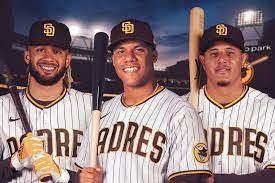
(Photo credit: Bleacher Report)
At 6 p.m. Tuesday, the 2022 MLB trade deadline officially commenced. Prior to that, a wave of deals culminated in one of the most frenzied trade deadlines in recent MLB history. As the window for trades has concluded, let’s look back and see who the winners and losers for this trade deadline were.
Biggest Winner: San Diego Padres
A case could be made that the Padres acquired the two best players during this trade period. On Monday, they acquired closer Josh Hader from the Milwaukee Brewers, helping them upgrade their bullpen at the closer spot (closer Taylor Rogers was traded to the Brewers in this deal). While that acquisition would be enough for most teams, the Padres didn’t stop there. On Tuesday, they acquired outfielder Juan Soto (and first baseman Josh Bell) from the Washington Nationals. By adding Soto, the Padres bolstered the middle of their lineup, as Soto joins shortstop Fernando Tatis Jr. and third baseman Manny Machado to form a scary trio. (Side note: Credit to the Padres for getting a deal done for Soto while working with Eric Hosmer to find a place for him as well).
While these acquisitions probably won’t be enough to help the Padres catch the Dodgers in the NL West race (the Dodgers are currently ahead by 11.5 games), they do make the Padres a threat in the postseason and a legitimate World Series contender.
Biggest Loser: Chicago Cubs
While the Cubs were able to get good value for relievers Scott Effross, Mychal Givens and closer David Robertson (according to MLB Pipeline, the Cubs acquired the Yankees seventh best prospect for Effross), they were unable to move catcher Willson Contreras, who will become a free agent after this season. If the Cubs are able to re-sign Contreras and extend outfielder Ian Happ (free agent after 2023) during the offseason, then this trade deadline looks a lot different. For now, Contreras is expected to sign elsewhere, leaving the Cubs with potentially nothing more than a draft pick.
Winner: Seattle Mariners
The Mariners were the initial big winners Monday, as they acquired arguably the best starting pitcher on the market, Luis Castillo (more on that later). After trading three of their top five prospects for Castillo, the Mariners acquired catcher Curt Casali and pitcher Matthew Boyd from the San Francisco Giants and infielder Jake Lamb from the Dodgers.
By pairing Castillo with pitchers Robbie Ray and Logan Gilbert, the Mariners have a legit 1-2-3 punch in the postseason, and they have a great chance at getting the top American League (AL) wild card spot (they are currently 2 games behind the Toronto Blue Jays). Also, while Boyd projects to join the Mariners bullpen, he fills a need: a lefty reliever who can pitch multiple innings.
Loser: San Francisco Giants
The Giants were in contention with the Cubs for my “Biggest Loser” of this deadline. However, they were able to get value for Casali, Boyd, reliever Trevor Rosenthal and first baseman/outfielder Darin Ruf. While they got value, there were two intriguing players that they didn’t trade: starter Carlos Rodón and outfielder Joc Pederson. Pederson will be a free agent this offseason, and Rodón has an opt out clause that most people expect him to exercise this offseason. Like the Cubs, both players will likely net the Giants draft picks in the event that they both become free agents and sign elsewhere.
Winner: New York Yankees
In any other year, the Yankees would likely be the biggest winners of the deadline. They started by acquiring outfielder Andrew Benintendi from the Kansas City Royals. They followed that up on Monday by acquiring Effross from the Cubs, and Frankie Montas (the other player in the conversation for the best starting pitcher on the market) and Lou Trivino from the Oakland A’s. They finished up their deadline dealing Tuesday by trading outfielder Joey Gallo to the Dodgers and acquiring outfielder Harrison Bader from the St. Louis Cardinals.
While the Bader trade left some fans scratching their heads (starter Jordan Montgomery was sent to the Cardinals), the Yankees filled a lot of needs. With Benintendi and Bader, they acquired two Gold Glove (given to the best defensive player at each position) outfielders that like to put the ball in play and steal bases. Also, the acquisition of Bader allows outfielder Aaron Judge to slide back to right field. Like Castillo with the Mariners, the Yankees are able to pair Montas with ace Gerrit Cole, All-Star Nestor Cortes Jr., and [hopefully] Luis Severino for the postseason. Finally, Effross and Trivino join a bullpen that lost Chad Green and Michael King to injury, but still employs relievers Jonathan Loáisiga, Chad Holmes, and Aroldis Chapman.
Loser: Cleveland Guardians
The Cleveland Guardians receive this title more for what other teams did than what they didn’t do. While standing pat isn’t automatic grounds for “losing” a trade deadline, it was for the Guardians this year. In a deadline that felt more like an arms race than simply acquisitions of talent, the Guardians watched as the Yankees, Mariners, Houston Astros, Minnesota Twins, and Blue Jays all made deals during this deadline. In fact, the only deal they made was with the Twins: catcher Sandy León for reliever Ian Hamilton.
Standing pat also doesn’t guarantee a slide, but with the Guardians currently being a game behind the Twins for the division and a game behind the Tampa Bay Rays for the last AL Wild Card spot, they probably could’ve used a boost, likely in the starting rotation or lineup.
Honorable Mentions
On the winners side, the Houston Astros and Cincinnati Reds are my honorable mentions. The Astros shored up their lineup by acquiring first baseman/outfielder Trey Mancini from the Baltimore Orioles and catcher Christian Vazquez from the Boston Red Sox, and bolstered their bullpen by acquiring Will Smith from the Atlanta Braves. The Reds won as sellers, getting good value for Castillo, starter Tyler Mahle, and infielder Brandon Drury.
On the losers side, the Boston Red Sox are my honorable mention. While they did trade Christian Vazquez, they held on to outfielder J.D. Martinez, starters Nathan Eovaldi and Rich Hill, reliever Michael Wacha, and utility man Enrique “Kiké” Hernandez, who are all impending free agents. They also traded for outfielder Tommy Pham and first baseman Eric Hosmer, sending the signal that they still want to compete for the wild card. Like the Cubs, if the Red Sox are able to re-sign third baseman Rafael Devers (free agent after 2024) shortstop Xander Bogaerts (can opt out this offseason), and a few of their free agents, this deadline can look different. However, recent history states that the Red Sox may not be willing to pay the money necessary to keep Devers and Bogaerts, which could lead to another Red Sox rebuild soon.
Who were your winners and losers from this year’s trade deadline? Share your thoughts in the comments below!
 Brian's Deductions
Leave a comment