
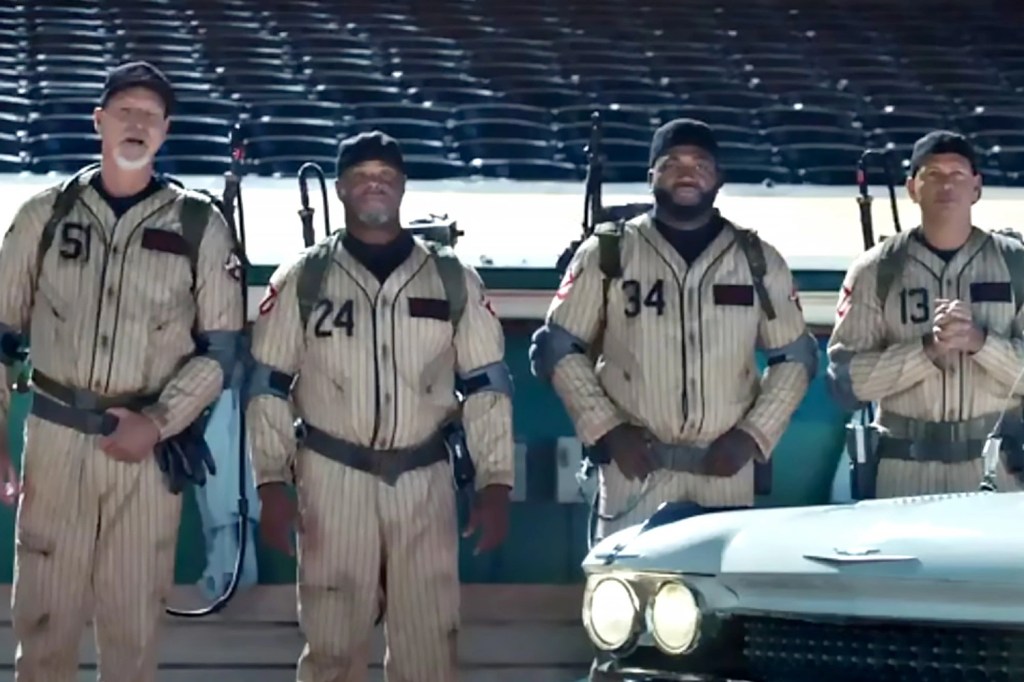
(Editor’s note: Part of the inspiration behind this article was this story in this video by Secret Base (watch from 14:49 to 15:59 under that version, or 1:42:51 to 1:44:01 under the supercut version. The other part of the inspiration was this DirecTV commercial.)
On November 28, 1992, the Seattle Mariners signed a 17-year-old first baseman out of the Dominican Republic named David Arias for $3,500. Four years later, Seattle would designate Arias as the player to be named later (PTBNL) in a trade with the Minnesota Twins for third baseman Dave Hollins. Today, 541 home runs (HR), 1,768 runs batted in (RBI), three World Series championships, and a name choice (Arias switched his preferred last name to Ortiz before making his MLB debut with the Twins; his full name is David Américo Ortiz Arias) later, Ortiz is in the Baseball Hall of Fame (HOF) after being inducted earlier this year. If he stayed in Seattle, Ortiz’s induction would’ve marked the fourth player from the 1996-97 Mariners team to make the HOF (Randy Johnson, Ken Griffey Jr., and designated hitter (DH) Edgar Martinez are the other). With that, the question remains: How would Seattle have fared if they kept David Ortiz?
Guidelines
For this “What if,” there will be a few guidelines/assumptions:
1.) Ortiz will play the same career length as he did in real life. Therefore, I will be starting from the 1996-97 season (the year Ortiz was traded) and ending with the 2016-17 season (Ortiz’s final year). While ’96-97 wasn’t his first year in the majors, the actual trade that season is what makes this article possible. He will also play with Seattle his entire career.
2.) Seattle still loses Johnson, Griffey and Alex Rodriguez via trade/free agency. While I thought about keeping Johnson for the full 1998-99 season, the key pieces Seattle received from the Johnson trade helped the Mariners remain in contention after he and Griffey were no longer there.
3.) Ortiz’s actual stats for each season will be listed. There won’t be any statistical projections (outside of Wins Above Replacement (WAR) in the 1999-2000 season) for each regular season, but I will discuss how I believe the team would’ve been affected in each year.
4.) Changes in team projections will be heavily dependent on Pythagorean W-L and Ortiz’s WAR. In the playoffs, changes in series will be based on the starting pitcher’s regular season records against the team they’re pitching against (in the projected World Series matchups, this was not as consistent, as Seattle didn’t face the Florida Marlins (now known as the Miami Marlins) or Colorado Rockies in the regular season before their respective series matchups).
1996-97 Season
Ortiz’s Minor League Stats: .322 batting average (BA), 89 runs scored (R), 34 doubles (2B), 18 HR, 93 RBI (Low-A/Single-A (A))*
Mariners record: 85-76, missed playoffs
Since Ortiz was still playing in the minors, he wouldn’t have had any impact on this season. The Mariners miss the playoffs.
1997-98 Season
Ortiz’s Minor League Stats (140 games): .317 BA, 90 R, 38 2B, 31 HR, 124 RBI (High-A (A+)/Double-A (AA)/Triple-A (AAA))*
Ortiz’s MLB stats (15 games): .327 BA, 10 R, 3 2B, 1 HR, 6 RBI, 0.1 WAR
Mariners record: 90-72, lost in AL Division Series (ALDS)
With first baseman Paul Sorrento and Edgar Martinez occupying the positions Ortiz could’ve played, I think he only gets one opportunity to impact the season: the chance to pinch hit for Sorrento in the ninth inning of Game 4 of the ALDS (pinch hitter Roberto Kelly struck out looking in the actual at-bat). Seattle still loses to the Baltimore Orioles in four games, as they still would’ve been down in Game 4 if Ortiz seized the opportunity and hit a home run.
1998-99 Season
Ortiz’s Minor League Stats (11 games): .243 BA, 5 R, 3 2B, 2 HR, 6 RBI (AAA)
Ortiz’s MLB stats (86 games): .277 BA, 47 R, 20 2B, 9 HR, 46 RBI, 0.7 WAR
Mariners record: 76-85, missed playoffs
Under the guidelines of this “What if?” universe, this is the only season where Ortiz, Johnson, Rodriguez, Griffey and Martinez all share the field as teammates. In what I believe would’ve been the first season Ortiz was in the majors, I think that he makes a nice impact, but not enough to turn the team’s situation around. Once Seattle traded Randy Johnson to the Houston Astros during the trade deadline (the Mariners acquired a couple of players who would help spark their next run of contention in starting pitcher Freddy Garcia and infielder Carlos Guillén), their season was basically over.
I believe that as the season went on, Ortiz would’ve been in a platoon system with first baseman David Segui (.305 BA, 79 R, 36 2B, 19 HR, 84 RBI, 3.2 WAR in 1998) despite Segui being a switch hitter (able to hit from both sides of the plate). Seattle still misses the playoffs, but Ortiz begins to make his way in the majors.
1999-2000 Season
Ortiz’s Minor League Stats (130 games): .315 BA, 85 R, 35 2B, 30 HR, 110 RBI, 1.1 WAR** (AAA)
Ortiz’s MLB stats (10 games): 25 plate appearances (PA), 5 walks (BB) .000 BA, 1 R, 0 2B, 0 HR, 0 RBI, -0.6 WAR
Mariners record: 79-83, missed playoffs
In what would be the last season for Ken Griffey Jr. in Seattle with this version of the team (he returned in the 2009-10 season), Ortiz gets his chance to become the full-time first baseman, as Segui (.293 BA, 43 R, 22 2B, 9 HR, 39 RBI, 0.6 WAR in 90 games with Seattle) was traded to the Toronto Blue Jays on July 28, 1999. While I don’t think Ortiz’s numbers would look exactly like his actual minor league stats, I do think he could get close, considering how many plate appearances he would have once Segui was no longer there. While his numbers would’ve helped the team’s offense improve slightly, his season likely gets Seattle to no higher than an 82-80 record, as the team’s Pythagorean W-L was 77-85. While an 82-80 record would give Seattle another winning season, they would still miss the playoffs, as it would’ve taken at least 94 wins to make the postseason (the Boston Red Sox clinched the AL wild card after winning 94 games, and the AL West division winner Texas Rangers won 95 games).
2000-01 Season
MLB Stats: .282 BA, 59 R, 36 2B, 10 HR, 63 RBI, 0.7 WAR
Mariners record: 91-71, lost in American League Championship Series (ALCS)
As stated in the previous season, Griffey still gets traded to the Cincinnati Reds (which ended up netting them center fielder Mike Cameron), as his reason for leaving Seattle (wanting to be closer to his family) still makes sense in this universe. Also, with Ortiz manning first base and Edgar Martinez at DH, Seattle does not sign 2000 AL Gold Glove winner (given to the best fielder at each position, excluding DH) and two-time World Series champion John Olerud (.285 BA, 84 R, 45 2B, 14 HR, 103 RBI, 3.7 WAR in 2000). Despite the loss of Olerud’s contributions and production from Ortiz that likely wouldn’t pass 1.5-2.0 WAR, Seattle still makes the playoffs, as their Pythagorean W-L was 92-70 that season. The team would need every win, as they clinched the AL wild card by one game (the runner-up Cleveland Indians (now Guardians) went 90-72).
In the ALDS, Seattle still makes quick work of the AL Central division winner Chicago White Sox, as their pitching staff generated a 1.93 earned run average (ERA) in the actual series. In the ALCS, Seattle still faces the New York Yankees. While Ortiz’s career postseason numbers against New York were legendary (53 PA, .333 BA, 7 BB, 10 R, 5 HR, 17 RBI in 14 games, 2004 ALCS Most Valuable Player (MVP)), part of that could be attributed to his familiarity with the team, as Boston and New York face each other 19 times a year during every season (excluding the playoffs). While his actual first postseason stats were nowhere near those stats (29 PA, .276 BA, 0 R, 3 2B, 0 HR, 4 RBI in 9 games with Minnesota), I think Ortiz’s numbers fall somewhere in the middle in this series. Seattle still falls to New York in six games, with the only key event I see Ortiz potentially affecting being in the ninth inning of Game 6 (Down 9-7 with the chance to tie, Martinez grounded out to end the game).
2001-02 Season
Ortiz’s Minor League Stats (14 games): .260 BA, 6 R, 4 2B, 0 HR, 2 RBI (AAA)
Ortiz’s MLB stats (86 games): .234 BA, 40 BB, 46 R, 17 2B, 18 HR, 48 RBI, 0.4 WAR
Mariners record: 116-46, lost in ALCS
In this season, Seattle waives goodbye to another star, as Alex Rodriguez signs with Texas (the 10-year, $252 million contract is still on the table here). However, they welcome another star to their team: 2001 MVP and Rookie of the Year (ROY) Ichiro Suzuki (242 hits (H), .350 BA, 127 R, 56 stolen bases (SB), 8 HR, 69 RBI, 7.7 WAR in 2001).
With Ichiro, Seattle tied the MLB record for most regular season wins with 116. In this universe, I think Seattle still wins close to 110 games (their Pythagorean W-L was 109-53), but they miss out on the record, as they slightly feel the absence of Olerud (.302 BA, 91 R, 32 2B, 21 HR, 95 RBI, 5.2 WAR, 2001 All-Star). Also, Seattle still beats Cleveland in the ALDS.
In the ALCS, Seattle gets a rematch with New York. Having Ortiz in this situation likely benefits Seattle more, as Olerud had a tough series (.211 BA, 2 BB, 2 R, 1 HR, 3 RBI, 4 SO in 5 games). Based on Ortiz’s real life history with New York and his overall approach, I think he could have a series close to the one he had in the 2003 ALCS (.269 BA, 3 BB, 4 R, 1 2B, 2 HR, 6 RBI in seven games). With this output, Seattle pushes New York to six games (with Seattle beating New York in Game 2, a game they lost in real life), but they lose the series again.
2002-03 Season
MLB Stats: .269 BA, 52 R, 32 2B, 20 HR, 75 RBI, 1.3 WAR
Mariners record: 93-69, missed playoffs
Despite good seasons from Ichiro and Edgar Martinez, along with Ortiz continuing his upward trajectory, Seattle still misses the playoffs, as they finished behind the AL West division winner Oakland Athletics (a.k.a. the Oakland A’s) and the wild card Anaheim Angels (now known as the Los Angeles Angels). Oakland won 103 games, while Anaheim won 99 games and went on to win the 2002 World Series.
2003-04 Season
MLB Stats: .288 BA, 79 R, 39 2B, 31 HR, 101 RBI, 3.4 WAR
Mariners record: 93-69, missed playoffs
Ortiz’s value starts to shine here in two ways. First, having Ortiz keeps Seattle from having to deal with Olerud’s decline (his WAR dropped from 5.1 in 2002 to 2.7 in 2003, with his offensive WAR (oWAR) dropping from 4.9 to 1.5, despite only playing two fewer games). Also, Ortiz being in Seattle hurts Boston’s playoff chances (Boston clinched the AL wild card that season). With Boston and Seattle being separated by two games, in addition to Seattle’s Pythagorean W-L being 97-65, Seattle clinches the AL wild card and advances to the postseason. It’s also likely that Seattle might’ve won the AL West outright, as Oakland won the division by three games (their Pythagorean W-L was 94-68). Like Boston in real life, Seattle beats Oakland in the ALDS, as their 12-7 record against Oakland in the regular season would support.
Beating Oakland leads to Seattle facing New York in the ALCS for the third time in four years. In a turn of events, with Ortiz, I believe Seattle follows Boston’s lead and pushes the series to seven games. I also think Game 7 plays out mostly like it did in real life (Boston pulled out to an early 4-0 lead, forcing Yankees starter Roger Clemens to leave the game and fellow starters Mike Mussina and David Wells to hold the lead where it was). However, I think Seattle’s bullpen, led by relief pitchers Rafael Soriano (3-0, 53 innings pitched (IP), 1.53 ERA, 1 save (SV)) Julio Mateo (4-0, 85.2 IP, 1 SV), and closer Shigetoshi Hasegawa (73 IP, 1.48 ERA, 16 SV in 17 opportunities) holds on, propelling them to the World Series.
In the World Series, while I think Ortiz produces stats similar to his 2004 Series production (.308 BA, 4 BB, 3 R, 1 2B, 1 HR, 4 RBI in four games), the Florida Marlins repeat history and win the championship in six games.
2004-05 Season
MLB Stats: .301 BA, 94 R, 47 2B, 41 HR, 139 RBI, 4.3 WAR
Mariners record: 63-99, missed playoffs
Even with Ichiro’s historic season (he set the single-season record for hits with 262) and an improvement at first base (Olerud’s WAR was 0.5) with Ortiz, the Mariners have a down year and miss the playoffs. This also marks the final season for Edgar Martinez, as he retires at the end of the year.
2005-06 Season
MLB Stats: .300 BA, 119 R, 40 2B, 47 HR, 148 RBI, 5.2 WAR
Mariners record: 69-93, missed playoffs
Despite an MVP-worthy season from Ortiz (ironically, he finished second in voting to Alex Rodriguez), and a Pythagorean W-L of 76-86, Seattle misses the playoffs again, as they would’ve needed 95 wins to clinch the AL West or wild card spot.
2006-07 Season
MLB Stats: .287 BA, 115 R, 29 2B, 54 HR, 137 RBI, 5.8 WAR
Mariners record: 78-84, missed playoffs
With outfielder Raúl Ibañez making the switch from DH to left field, Ortiz is able to move from first base to DH. This allows Richie Sexson to take over at first base (in this universe, Sexson still signs with Seattle in 2004 despite Ortiz being there). I believe this switch for Ortiz would allow him to put up comparable numbers to the ones he actually did in real life, likely helping Seattle pick up a few more wins. However, his Herculean effort wouldn’t be enough, as Seattle would need at least 93 wins to make the playoffs (Oakland won the AL West with 93 wins, and the Detroit Tigers clinched the wild card with 95 wins).
2007-08 Season
MLB Stats: .332 BA, 116 R, 52 2B, 35 HR, 117 RBI, 6.4 WAR
Mariners record: 88-74, missed playoffs
Like the ’03-04 season, Ortiz helps Seattle get in the playoffs over Boston. Since Boston doesn’t have Ortiz, they likely win less than 96 games, allowing New York to leapfrog them for the AL East crown. From there, Seattle likely wins enough games (between 92-94) and knocks out the team that they owned a 5-4 head-to-head record over in the regular season. Also, his presence helps Seattle contend for the AL West, as they finished six games behind Los Angeles (with a 6-13 head-to-head record) and featured José Vidro (.314 BA, 78 R, 26 2B, 6 HR, 59 RBI, 1.4 WAR) as their DH in real life.
In the ALDS, Seattle would face Cleveland, the AL Central division winner. With Ortiz likely matching the 2007 postseason production he had against Cleveland in real life (.292 BA, 7 R, 3 2B, 1 HR, 3 RBI in seven games), Seattle pushes the series to five games and wins, as Ortiz comes up clutch against 2007 AL Cy Young Award winner CC Sabathia in Game 5 to send the Mariners to the ALCS.
In the ALCS, Seattle would face Los Angeles. With Ortiz possibly replicating most of his 2007 postseason production against the Angels in real life (.714 BA, 5 R, 2 HR, 3 RBI in three games), Seattle pushes the series to seven games, and Ortiz puts the team on his back again as he helps the Mariners beat LA starter John Lackey (who was 4-0 against Seattle in the regular season) in Game 7 to advance to the World Series (Ortiz had a HR and 2 RBI against Lackey in the actual 2007 ALCS).
In the World Series, Seattle faces the upstart Colorado Rockies. Ortiz puts up comparable stats to his real-life 2007 Series production (.333 BA, 4 R, 3 2B, 4 RBIs in four games), and the Mariners win in six games. After a little discussion, Ortiz wins the World Series MVP award, cementing his status as one of the game’s best players.
2008-09 Season
MLB Stats: .264 BA, 74 R, 30 2B, 23 HR, 89 RBI, 1.7 WAR
Mariners record: 61-101, missed playoffs
In what coincides with a down year from Ortiz, Seattle fails to make the postseason, ending their quest to repeat.
2009-10 Season
MLB Stats: .238 BA, 77 R, 35 2B, 28 HR, 99 RBI, 0.7 WAR
Mariners record: 85-77, missed playoffs
In this universe, Ken Griffey Jr. still returns to Seattle. Also, since he only played 38 games in the next season before retiring, the 2009-10 season will be his last season. Since Griffey spent most of his time at DH that season, Ortiz moves back to first base, relegating Russell Branyan (who still signs with Seattle in this universe) to the bench.
Despite an excellent season from starter Félix Hernández (19-5, 2.49 ERA, 217 strikeouts (SO), 1.14 walks + H per IP (WHIP)), Seattle misses the postseason, as they would need at least 95 wins to clinch a spot. Unlike 2003 and 2007, Boston doesn’t miss Ortiz’s presence as much, and they still clinch the AL wild card with 95 wins.
2010-11 Season
MLB Stats: .270 BA, 86 R, 36 2B, 32 HR, 102 RBI, 2.8 WAR
Mariners record: 61-101, missed playoffs
In this year, with Griffey’s retirement, Ortiz moves back to DH, allowing new acquisition Casey Kotchman to occupy first base. Despite a bounce back season from Ortiz and a year where Hernández won his first—and only—Cy Young Award, Seattle misses the postseason again.
2011-12 Season
MLB Stats: .309 BA, 84 R, 40 2B, 29 HR, 96 RBI, 4.0 WAR
Mariners record: 67-95, missed playoffs
Another great season from Ortiz is not enough, as Seattle fails to qualify for the postseason.
2012-13 Season
MLB Stats: .318 BA, 65 R, 23 HR, 60 RBI, 3.2 WAR
Mariners record: 75-87, missed playoffs
In what would be Ichiro’s last season with this version of the team (like Griffey, he would return to Seattle for his last two MLB seasons), Seattle misses the postseason for the fifth straight year.
2013-14 Season
MLB Stats: .309 BA, 84 R, 38 2B, 30 HR, 103 RBI, 4.4 WAR
Mariners record: 71-91, missed playoffs
Despite the addition of a second wild card (and a wild card game) for both leagues, Seattle misses the postseason again. Despite the tough season as a team, Ortiz produces another great year to bolster his Hall of Fame résumé.
2014-15 Season
MLB Stats: .263 BA, 59 R, 27 2B, 35 HR, 104 RBI, 2.6 WAR
Mariners record: 87-75, missed playoffs
In this universe, Seattle still decides to pursue second baseman Robinson Canó (.314 BA, 77 R, 37 2B, 14 HR, 82 RBI, 6.3 WAR in 2014). Also, since Ortiz is at the DH position, Seattle does not sign Corey Hart (-0.5 WAR in 2014). With Ortiz replacing Hart’s production, plus Seattle’s Pythagorean W-L being 91-71, the Mariners squeak into the postseason, grabbing one of the two AL wild cards (likely over Oakland, who Seattle possessed a 10-9 head-to-head record over).
In the wild card game, Seattle faces the Kansas City (KC) Royals, who they owned a 5-2 head-to-head record over. Seattle wins, as starter Hisashi Iwakuma (1-0 against KC in the regular season; the team went 2-0 in his starts) beats Royals starter James Shields (0-0 against Seattle in the regular season; the team went 0-1 in his lone start). Iwakuma starts this game because Hernández started in the regular season finale in real life.
In the ALDS, Seattle faces Los Angeles, who they possessed a 12-7 head-to-head record over. Both teams trade victories throughout the series, with Seattle winning in five games. Hernández (3-0 against LA in the regular season; the team went 5-0 in his starts) beats Angels starter Jered Weaver (1-2 against Seattle in the regular season; the team went 2-2 in his starts) in Games 1 and 5 to help Seattle advance to the ALCS.
In the ALCS, Seattle faces Baltimore, who they went 2-5 against in the regular season. Like the ALDS, both teams trade victories, leading to a seventh game. While I believe Ortiz would have a series close to his 2013 ALDS production (.385 BA, 5 BB, 4 R, 1 2B, 2 HR, 3 RBI in four games), Orioles starter Wei-Yin Chen (2-0 against Seattle in the regular season) beats Hernández (0-0 against Baltimore in the regular season; the team went 0-1 in his lone start) in Games 3 and 7 to help Baltimore advance to the World Series.
2015-16 Season
MLB Stats: .273 BA, 73 R, 37 2B, 37 HR, 108 RBI, 3.1 WAR
Mariners record: 76-86, missed playoffs
In the offseason, Seattle still signs outfielder/DH Nelson Cruz (.302 BA, 90 R, 22 2B, 44 HR, 93 RBI, 5.1 WAR in 2015) in free agency. Despite stellar seasons from Cruz, Canó, Hernández and Ortiz, Seattle misses the postseason.
2016-17 Season
MLB Stats: .315 BA, 79 R, 48 2B, 38 HR, 127 RBI, 5.2 WAR
Mariners record: 86-76, missed playoffs
In Ortiz’s final season, with Seattle moving Nelson Cruz to DH, he moves back to first base (first baseman Logan Morrison and DH Mark Trumbo left in the offseason). With this move, Seattle does not sign first baseman Adam Lind (-0.3 WAR in 2016). Like 2014, with Ortiz’s production, plus the team’s Pythagorean W-L of 87-75, Seattle grabs one of the two AL wild cards. While Boston likely misses Ortiz (and it can be argued that they might slip into the wild card position instead of winning the AL East), their Pythagorean W-L was 98-64, so they still win the division. Since the Toronto Blue Jays held a 10-9 head-to-head record against Boston and Baltimore respectively, they clinch the other AL wild card and meet Seattle in the wild card game. In the game, Seattle beats Toronto, as starter James Paxton (1-0 against Toronto in the regular season, 7 IP, 1 earned run (ER) allowed) beats Blue Jays starter Marcus Stroman (did not pitch against Seattle in the regular season; threw 6 IP and allowed 2 ER in the actual wild card game) to help them advance to the ALDS.
In the ALDS, Seattle faces Texas, who they went 7-12 against in 2016. Despite their best efforts, Seattle gets swept, losing in three games to their division rival.
Review
In 20 seasons with Minnesota and Boston, Ortiz made the postseason nine times, the ALDS nine times, the ALCS six times (once with Minnesota and five times with Boston), and won three World Series (along with the 2013 World Series MVP) in three appearances (all with Boston). In this “What if,” Ortiz made the postseason seven times (twice as a wild card), the ALDS seven times, the ALCS five times, and won one World Series (and the 2007 World Series MVP) in two appearances with Seattle. This scenario shows how important having a strong team around a star player is, as Ortiz dealt with multiple sub-.500 seasons (including a few 90+ loss seasons) and six straight seasons where Seattle missed the playoffs.
On Boston’s side, under this scenario, it can be argued that they only win one championship (possibly none) during Ortiz’s tenure. Without Ortiz’s timely hits in Games 4 and 5 of the 2004 ALCS, it’s hard to imagine Boston beating the Yankees, let alone winning the World Series. Also, the aforementioned 2007 championship switched hands from Boston to Seattle in this universe. Finally, without Ortiz’s MVP performance in 2013, that World Series could be a toss-up (their opponents, the St. Louis Cardinals, won the 2011 World Series, and the 2013 Series went six games with Ortiz’s contributions).
While Ortiz is revered in Boston for winning multiple championships (especially the 2004 championship), I think winning one in Seattle would make him (along with Ichiro and Félix Hernández) legends forever. Also, while he wins fewer championships with Seattle, I believe Ortiz’s career stats would’ve been comparable to what he did in Boston, leading to him still being inducted into the Hall of Fame. In this universe, Ortiz goes in with a Seattle hat on his plaque, allowing him to join Griffey and Edgar Martinez as players recognized as Mariners in the Hall of Fame (Randy Johnson’s HOF plaque displays him with an Arizona Diamondbacks hat).
How do you think Seattle would’ve fared? How do you think Ortiz’s career arc goes? Share your thoughts in the comments below!
*The levels of minor league baseball [in order] are: Rookie Ball, Class A Short Season, Low-A/Single-A (A), High-A (A+), Double-A (AA), and Triple-A (AAA).
**This WAR was projected, as Baseball Reference did not have WAR recorded for Ortiz’s minor league seasons. The WAR formula for position players is: WAR = (Batting Runs + Base Running Runs + Fielding Runs + Positional Adjustment + League Adjustment + Replacement Runs) / (Runs Per Win). For more details on this equation, check out this article.
 Brian's Deductions
Leave a comment