
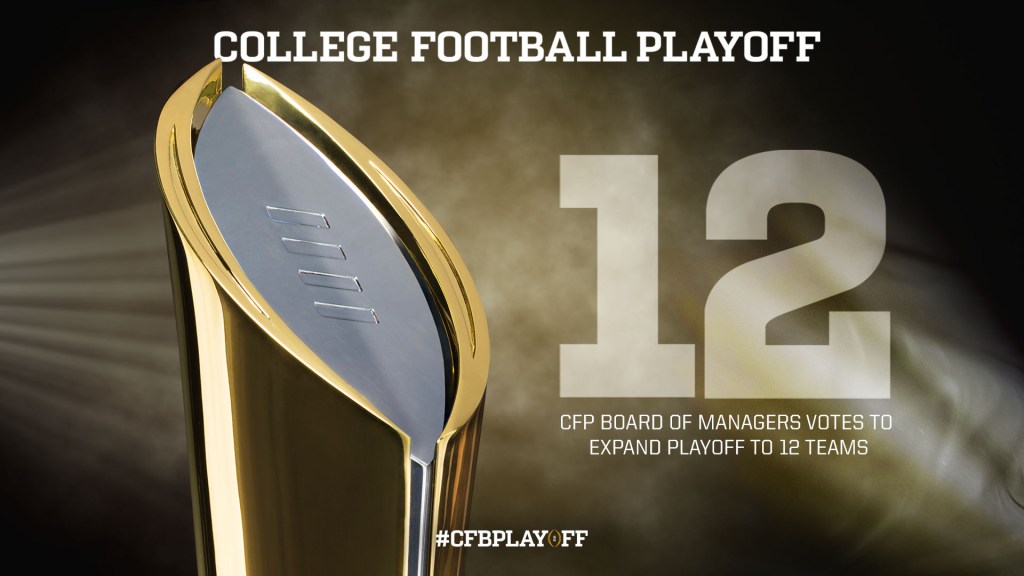
On September 2, 2022, the Board of Managers, a group of university presidents and chancellors that oversees the College Football Playoff (CFP), voted unanimously to expand the playoff from four teams to 12. Expansion is expected to take place in 2026, but the College Football Playoff Management Committee (the Power Five and Group of Five conference commissioners and the Director of Athletics at the University of Notre Dame, who run the playoff) are working towards expanding the playoff as soon as the 2024 season. As preparation is underway, one question has emerged: What will the expanded playoff format look like? With that in mind, here’s my proposal for the expanded CFP.
Power Five + Best Group of Five Conference Championship Winners (6 teams)
The Power Five consists of the Atlantic Coast Conference (ACC), Big Ten Conference, Big 12 Conference, Pac-12 Conference, and Southeastern Conference (SEC). The Group of Five consists of the American Athletic Conference (AAC), Conference USA (C-USA), Mid-American Conference (MAC), Mountain West Conference (MWC), and Sun Belt Conference. For the Group of Five, the conference champion with the best record will automatically get in the CFP. In the event of a tie, the metrics the CFP selection committee use now (strength of schedule, strength of record, etc.) will be used to determine the better team. This requirement for the Group of Five could lead to more interconference matchups (imagine a Cincinnati-Louisiana matchup last season) in the future to help with potential head-to-head and strength of schedule tiebreakers.
This framework also does two things for college football as a whole: Giving the Group of Five a legitimate chance to make the CFP, and keeping conferences relevant despite realignment (e.g., USC and UCLA to the Big Ten and Oklahoma and Texas to the SEC). Under this format, the 2017 University of Central Florida (UCF) Knights would make the playoff, as they went 12-0 in the regular season. For the Big 12 and Pac-12 conferences, who lost the aforementioned teams to the Big Ten and SEC, this format could help keep their teams—along with the ACC—from looking to join the Big Ten and SEC to improve their CFP chances. While realignment will likely still take place regardless of the format provided, this could possibly slow down the pace of realignment for now.
Another positive from this layout is that it would make conference championship games even more important. For example, a 9-3 team could beat a 12-0 team and get in the CFP. While that may seem detrimental to some, we could see the conferences adopt the Big 12 strategy and go away from divisions within the conference. If this happens, the two teams with the best overall record would duel in the conference championship game. In this scenario, we could see teams that might’ve been eliminated due to being in the same division get the chance to play. For example, the Big Ten could have a Michigan-Ohio State conference championship game after “The Game” (the annual rivalry game between the two teams) if they went away from divisions. While that could make rivalry games seem watered down, giving a potential advantage for winning that game going into the conference championship game could assuage concerns.
At-Large Bids (Power Five + Group of Five + Independent Teams) – 6 teams
Here, the other Group of Five championship teams, all the non-championship teams from the conferences mentioned, and schools like Notre Dame and Brigham Young University (BYU)—who is planning to join the Big 12—will be eligible here. This format works wonderfully for Notre Dame, as they would still have the chance to make the CFP every year while staying independent. This could also work for Group of Five teams, although they would likely have to lose one game or less to jump over Power Five teams.
How would this look?
Under this proposed format, these are the 12 teams that I would’ve voted to make the CFP last season:
1. Alabama (12-1, SEC Champion)
2. Michigan (12-1, Big Ten Champion)
3. Baylor (11-2, Big 12 Champion)
4. Pittsburgh (11-2, ACC Champion)
5. Utah (10-3, Pac-12 Champion)
6. Cincinnati (13-0, AAC Champion)
7. Georgia (12-1, At-Large Bid)
8. Notre Dame (11-1, At-Large Bid)
9. Louisiana (12-1, At-Large Bid; Sun Belt Champion)
10. Ohio State (10-2, At-Large Bid)
11. Oklahoma State (11-2, At-Large Bid)
12. Houston (11-2, At-Large Bid)
While these teams aren’t ranked in order and likely wouldn’t reflect the 12 teams that the CFP selection committee would’ve chosen, there are two SEC teams, two Big Ten teams, two Big 12 teams, one ACC team, one Pac-12 team, three Group of Five teams (including two conference champions), and one independent team (Notre Dame) within the 12 I picked. The 12-team format could provide moments like this where the wealth is spread, and we can only hope that it will reflect something similar to this.
How would you organize the 12-team College Football Playoff format? Which teams would you have picked from last year (doesn’t have to be in order)? Share your thoughts in the comments below!
 Brian's Deductions
Leave a comment